HERITAGE
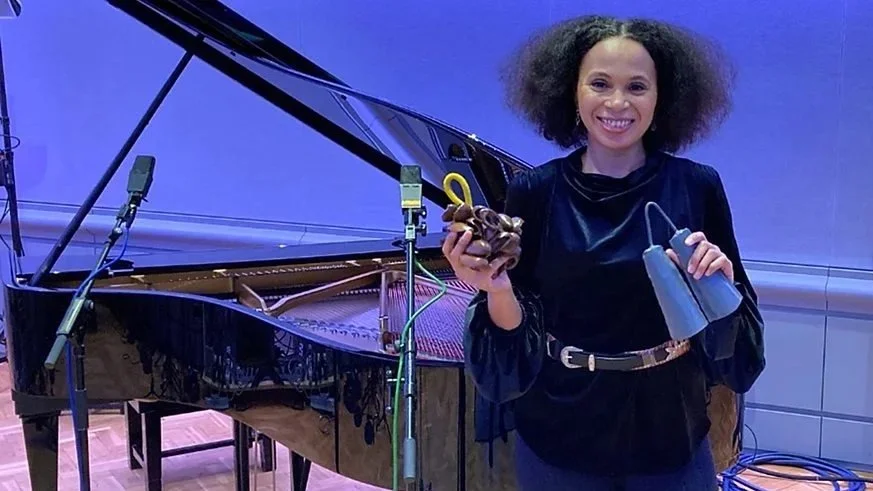
I have built my career pioneering AFRICAN PIANISM through performances and recordings, but this was not a formal academic term I studied as a child, but rather a lived experience of my heritage that I later reconciled with my Western classical training. It meant learning to see the piano not just as a Western classical instrument, but as a way to express African culture, rhythm, and identity. For me, African Pianism was A Natural Expression of Heritage. I grew up hearing my father sing Igbo songs, and this oral tradition made African rhythms and melodies a natural part of my early sound world, long before I formally researched the genre.
African Pianism was The Musical Legacy of Family - it meant connecting the piano to my ancestral roots following in the footsteps of my paternal grandfather, ANINYE OMORDIA, who had been a famous traditional musician, often being invited to perform at the kings’ courts in the Kingdoms of Ika and the Benin Kingdom. Grandfather performed traditional music on the owka akpere, a flute of the Anioma region of Nigeria, accompanied by percussion instruments. While I never met my grandfather, I grew up with my father singing Igbo traditional songs, and it was natural that later in my life I would want to discover more about African classical music.
Performing African Pianism repertoire gave me Freedom from strict rules. Instead of only following rigid classical techniques, I experienced the piano as something rhythmic, physical, and expressive. It was liberating! And it gradually turned into a Mission, as my early experiences planted the idea that African music belonged on the classical stage, which later inspired my career as a performer, researcher, and advocate.
I was born in Romania during Ceaușescu’s communist regime to a Nigerian Igbo father and a Romanian mother. Raised between two cultures, I grew up with a deep awareness of both worlds—an inheritance that continues to shape my artistic voice. My father, a pediatrician, came to Romania from Nigeria to study medicine, where he met my mother. I was trained within Romania’s rich classical music tradition, I studied at the National Conservatoire in Bucharest before continuing my education in England. London became the place where I found creative freedom and a sense of belonging, supported by my Nigerian family, and it is here that I chose to make my home.
In Nigeria, one claims the father’s homeland. When I arrived, I was welcomed as “a daughter of the land,” a role that carried both responsibility and belonging, requiring me to align myself with its cultural traditions. This immersion led me to the discovery of Nigerian art music—a vast 20th-century lineage in which composers fused ancestral sound worlds with Western classical forms. From this discovery emerged my African Pianism albums and The African Concert Series in London, created to bring this repertoire to wider audiences. My journeys also led to close collaborations with the Musical Society of Nigeria MUSON, with performances in Lagos and Abuja.
Alongside my exploration of African piano music, I immersed myself in the English repertoire. While at Birmingham Conservatoire, I won the Delius Prize, adjudicated by Julian Lloyd Webber, who later invited me to become his duo partner. From 2012 to 2014 we toured the UK, performing British Music. After his retirement, I continued to focus on English music, developing a special affinity for John Ireland’s piano works, which I performed extensively, recorded and also wrote my Doctors thesis on this topic.
Today, I am asked “who am I as a pianist"? I believe we become the result of our environment, of our choices and opportunities. I’ve always loved playing the piano and I’ve always chosen to perform music that speaks to me, so it is natural for me to perform African Pianism but also Western repertoire and English Music.
Rebeca plays music by Romanian composer George Enescu
Spotlight video for the 2016 Igbo Women Awards, London